What were the context and challenges of the Shortways project?
Sophie Bordeaux-Montrieux: Louvre Hotels Group is a major player in the global hospitality industry, with a portfolio of 1,700 hotels across 70 countries. Since 2015, the Group has been a subsidiary of Jin Jiang International Holdings, the second largest hotel group in the world.
After 9 years without any major digital change, Jin Jiang and Louvre Hotels Group wanted to establish an efficient, intelligent, and agile financial platform through the deployment of a new financial ERP, managed by a new Shared Services Centre.
This project had two main phases:
-
- A preparation phase, known as DRAGON, which was completed in 2019, and which served to define target business processes and formulate IT improvement recommendations.
- An implementation phase, known as SILK, aimed at deploying Oracle ERP Cloud across 7 countries, during which the new organisational structure is being progressively put in place. This phase began in 2021 with France, covering hotels and head offices. The remaining countries will be deployed from June 2026 onwards.
Our programme rests on three simultaneous challenges:
-
- The first challenge is achieving common alignment around Finance processes at a European scale. This covers all major accounting and procurement cycles: Purchase-to-Pay (P2P: accounts payable), Order-to-Cash (O2C: accounts receivable), Cash Management (treasury, bank reconciliation statements), Record-to-Report (R2R: general ledger), as well as FP&A processes (management accounting).
- The second challenge is the integration of Oracle Cloud Platform Finance (Enterprise Resource Planning) across the entire scope, after 9 years without any major digital change within the Finance function.
- Finally, the third challenge concerns the outsourcing of certain Finance activities to a partner.
In practical terms, at this stage of the programme, this represents 263 hotels with 26 entities across 7 European countries.
One of the keys to success in such a project is precisely the establishment of a Change team. This is one budget that should not be underestimated. We therefore put in place a substantial Change team to manage all aspects of change management, namely communications, training, onboarding journeys, online documentation creation, videos, and the Shortways digital assistant, amongst others.
My team is made up of several profiles, both specialised in change management and in the Oracle platform. It supports, amongst others, Hotel Directors and head office teams, and covers training, communications, and engagement throughout the implementation of our SILK programme.
What is Kaora Partners’ role in this project?
Olivier Dupret: Kaora Partners is involved in two main areas within this project:
-
- Firstly, one team handles the Oracle Cloud ERP integration. Kaora was brought in during 2025 and early 2026 to deploy several hotel waves following the initial wave that took place in 2022.
- Secondly, a change management advisory (PMO/AMOA) workstream, covering both the Hotel Directors who use the Oracle system, and the teams from several head office departments who are also users.
Kaora Partners was chosen to support Louvre Hotels on change management for three reasons:
-
- Firstly, for its Oracle expertise. We have had longstanding knowledge of the Oracle system itself.
- We bring seniority across ERP implementation projects, with a recognised competence in user training in particular. We understand project dynamics, the challenges involved, the various project phases, and the different stakeholders we encounter in these assignments.
- And finally, our in-depth knowledge of Finance, Accounting, and Procurement functions, which is essential for proposing solutions that are genuinely tailored to the needs of these audiences.
Why did you choose Shortways?
Sophie Bordeaux-Montrieux: The initial thinking around a digital assistant emerged during the stabilisation phase of the first deployment wave, which took place in 2022 across the hotels and head office entities.
Indeed, in autumn 2024, a feedback review was conducted across the 28 hotels deployed in 2022. This revealed several key needs:
-
- Enhanced support for tool usage: daily and in real time, at the moment when a Director needs help. Our Directors have very little time for administrative tasks. Their day-to-day focus is on guest management and hotel operations. They therefore need help at the moment they carry out their admin, which is where a digital solution proves its worth — the Change team is not necessarily available at that point.
- Clarification of business processes and the organisation. Particularly because things are very fluid and change frequently. The goal was to be able to provide information quickly.
- Support for upskilling new users. As the Change team is tied to the project, once the project ends and new Directors or other colleagues join head office, something permanent was needed to help them get started on Oracle.
It was becoming clear to us that user support could not be maintained at the same level of engagement and responsiveness given the new deployments planned for 2025. 28 hotels had been deployed in 2022, but across 2025 and 2026 we were looking at over 150 hotels being deployed. On top of this, a major Oracle version upgrade called Redwood was added to the 2025 roadmap, requiring additional training and support effort, as this upgrade had a significant impact on our users, particularly around the use of purchase requests in Oracle. All of these reasons pushed us towards adopting a digital adoption platform.
What led us to choose Shortways was that internally, we had at the time assessed several providers, and a POC had been organised by IT with a competitor, which had not convinced them. Subsequently, Kaora Partners introduced us to Shortways. Following demos and discussions that were satisfactory and met our requirements, we made the decision to go with Shortways.
Olivier Dupret: The Shortways deployment covered three different user populations:
-
- Hotel Directors,
- Business Owners for head office entities,
- and PMOs, responsible in particular for hotel renovations.
The Shortways project was slotted into the overall hotel deployment schedule, with a first pilot phase carried out in January 2025.
The assistant is available in two languages: French and English. Its initial content evolved throughout the project. During the project, we had several software updates, most notably with the introduction of the new Redwood screens for the Procurement cycle, which affected all of the user populations mentioned above. This ERP update was rolled out progressively, we began in April 2025 and it was then phased in over time.
The Shortways content therefore evolved and adapted to the constant changes in screens, as well as to the improvements and developments in our organisation and business processes throughout the project.
Some use cases
Sophie Bordeaux-Montrieux: At Louvre Hotels Group, the Shortways assistant integrated into Oracle has been renamed Hélio. It is a digital tool that guides, trains, and assists users in real time, directly within their working environment.
In practical terms, Hélio enables:
- Keyword search via the assistance bar,
- Centralisation of documentation, with easy access to training content (FAQs, internal procedures, etc.) without leaving Oracle,
- Step-by-step guidance through interactive tutorials to walk users through processes, such as raising a purchase request, goods receipt, or reviewing an invoice,
- And the display of contextual and intelligent help bubbles or pop-ups, directly within Oracle, tailored to the current screen and action.
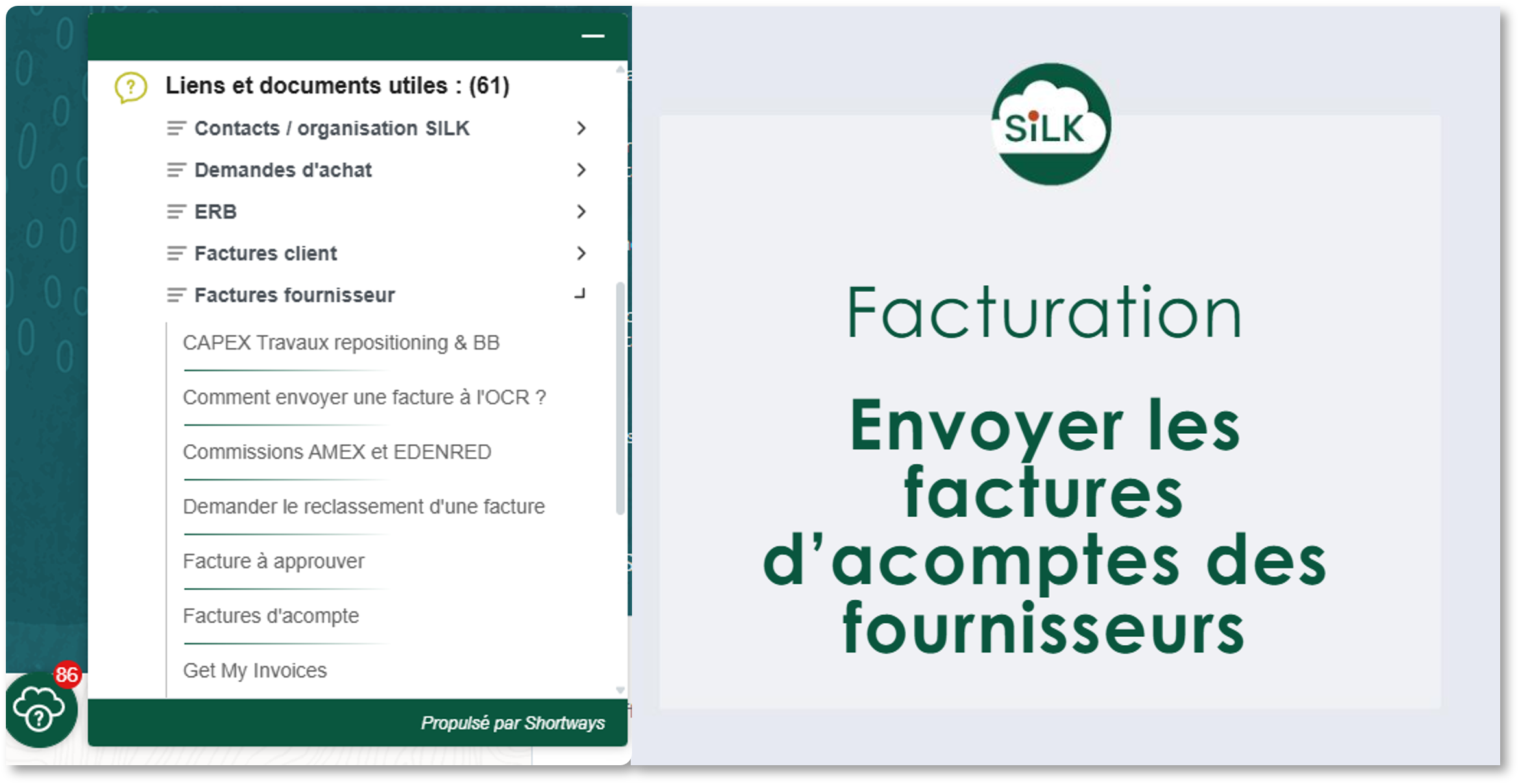
Olivier Dupret: First, we use FAQs. You can see in this example that we have several documentation sections. In this instance, we redirect to an online document on ‘How to send deposit invoices from suppliers for posting’: a Hotel Director who needs to know how to process a deposit invoice compared to their usual invoices can simply query Shortways and click on this step-by-step guide, which takes them directly to the online procedure.
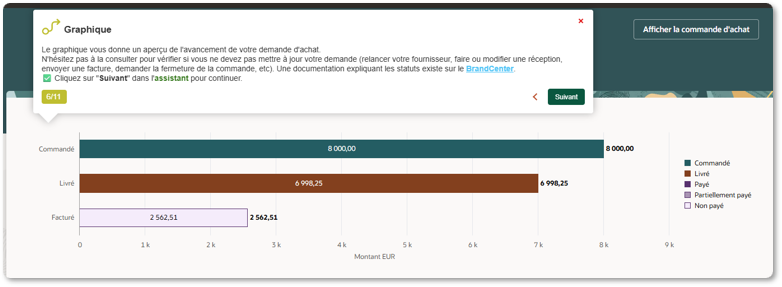
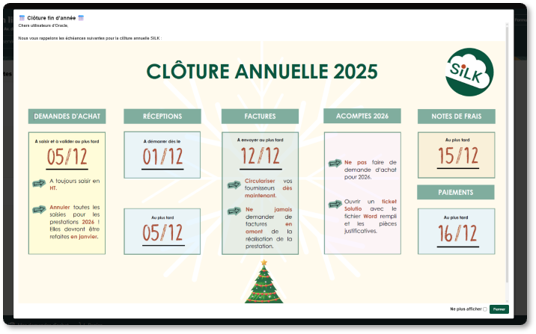
We also use other types of content, such as contextual notifications. The first screenshot showing several boxes with dates inside is a communication, a notification that appeared at the end of last year for all users to remind them of the key year-end closing deadlines.
Notifications are a very effective way of encouraging GMs to pay attention to these dates, as when they log in, this message inevitably appears. It is also communicated by email, but we generally send communications three times across our various channels.
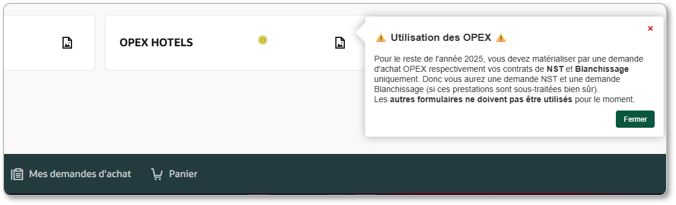
We also have other types of notifications. At the bottom of the page, we can see a notification that appears to explain the usage of a form on a purchase request page, specifying that this form is intended for certain specific purposes and not for others. This notification is currently permanent, but will be removed in due course once the process has evolved.
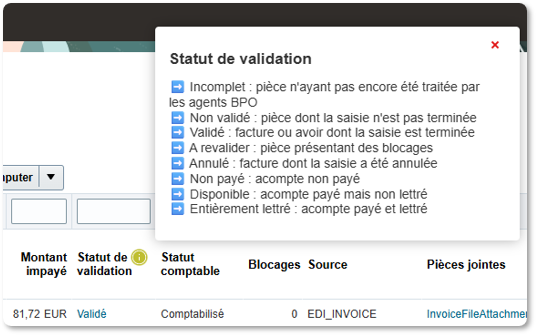
Finally, we have help bubbles, as shown here in the top right-hand corner, for example, an explanation of what a particular invoice validation status means. We have several statuses, and it is not always immediately intuitive for a user to understand what a given status means. So, with the help of the small bubble, they can instantly see what it means, without necessarily having to contact the Change team to ask ‘I have an invoice with the status “to be revalidated”, what does that mean?’ They will have the information straight away.”
These are just a few examples of the very many pieces of content we have put in place.
Feedback on the deployment
Sophie Bordeaux-Montrieux: Following the use of Shortways, we were able to identify several meaningful and telling KPIs:
First, at an overall level we have:
-
- 425 pieces of content published
- 457 users who have consulted Shortways content
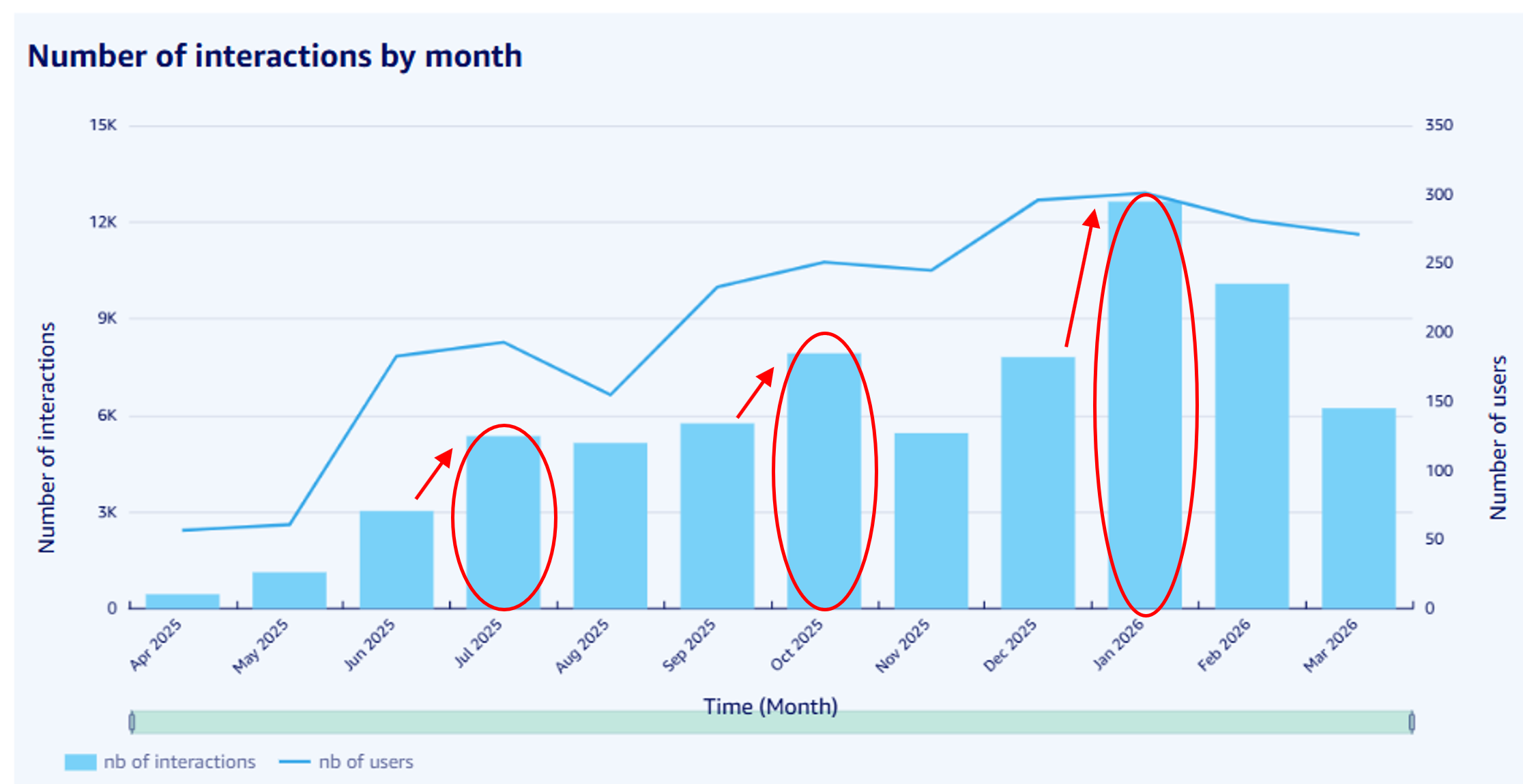
- On the chart, we can see peaks in interactions corresponding to the deployment waves in July 2025, October 2025, and January 2026. This is precisely why we put Shortways in place. In between these peaks, the figures drop as users grow increasingly confident and naturally need to consult the help content less. The trend builds progressively, which also demonstrates that we succeeded in embedding the use of Shortways as our own Change team grew more proficient with it over time.
-
- Finally, we found that 60% of employees used the search bar to look for help: over 5,500 searches carried out, averaging 12 searches per user. The statistics also show us the most searched keywords, those that returned no results, and searches where users flagged missing content, all of which helps us continuously identify where we need to create new support content.
Shortways statistics also allow us to drill down into the data by feature and identify best practices. On the step-by-step side, we were pleased to see that 1,890 step-by-step guides had been launched since go-live (almost 9 per user), and to have the breakdown of the most-used guides: “Review an Invoice”, “View my CAPEX and OPEX”, “Query the Repository”, and “Receive a Purchase Order”.
Likewise for FAQs, with an average of 7 FAQs consulted per employee across a range of topics: remittance advices, invoices to approve, payment runs, stock counts, and more.
Best practices
Olivier Dupret: We put in place several best practices, including:
-
- Targeting and tailoring content by user population: Directors do not have quite the same content as head office users or PMOs. Each piece of content is adjusted to their needs.
- Using the Shortways translation tool for content to be transposed into English. This is very practical, as beyond translating the content itself, it also duplicates it, we do not have to start from scratch. It is simply a matter of reviewing and where necessary correcting a translation to fit the Louvre Hotels context, or adjusting a target if it differs from the French version, but the bulk of the work is already done.
- Regarding step-by-step guides:
- Arbitrating between clicking on the target and clicking on the button, to ensure the smoothest possible journey.
- Multi-entry starting points, so that if a user is mid-process and wants to launch the guide, they are not forced to go back to the beginning but can pick it up from where they are.
- Conditioning certain steps based on what is visible on screen.
- Also very important in terms of best practices is adjusting the positioning of content for better usability. If there are elements the user needs to click on, or help bubbles positioned in corners, we try to ensure the bubbles display in a visually balanced way across the page.
- On certain notifications, we have disabled the option to close them, to ensure the notification appears and that the user cannot dismiss it. In some cases, we repurposed this feature to block certain functions on screen that could not otherwise be blocked. The use of Shortways can therefore extend to this type of requirement.
- Finally, a content tracking file is kept up to date to oversee everything: which pieces of content have been recently updated, which are slightly older, which new pieces are being added, and so on. This provides a clear overview of everything in a single Excel file, rather than having to go into the console and potentially search through the administration page for content.
These are the best practices we have put in place for our Shortways deployment.
We were also able to identify three key success factors for this project:
-
- The first is having a thorough understanding of the business processes on which the assistant will be based. The assistant draws on these business processes to deliver content. Without a solid grasp of the business process from the outset, it will be difficult to have an assistant that genuinely meets users’ needs and expectations.
- The second is prioritising rules and processes that are somewhat complex, poorly understood, or likely to generate errors amongst users. We have a great deal of content today, but not everything was available from the start — we first focused on what was critical.
- The third, and most importantly, is not relying exclusively on the assistant, as technology never replaces the human element. The assistant complements an existing setup, in support of a human-led approach. It brings its own advantages and helps lighten the load on that human layer, but does not replace it.
What’s next for the project?
Sophie Bordeaux-Montrieux: Following the success of Shortways on the Oracle deployment, it was decided to roll it out on another financial tool, MoneyTime. MoneyTime is a tool that enables cash reconciliation for our hotels.
Using Shortways was a natural choice for three reasons:
- We have user profiles who need instant information, without having to consult documentation,
- Furthermore, cash reconciliation is a rigorous process with an impact on other systems and on accounting: a solid command of the tool is essential,
- The sale of a cash management solution to franchised hotels with the Shortways support package included.
Thank you to Sophie and Olivier for sharing their feedback!